Last we had filed a despatch on the tradition of loan waivers in ancient civilisations. We talked about the evidence on the ground in the shape of the Hammurabi Tablets and the Rosetta Stone...The physical relics are not just so many zeroes at a Sotheby auction, but are authentic indicators of the evolution of human thought- the natural progression- the Gangotri of Ideas that must be remembered if we want peace on Earth and goodwill towards men...
Today we walk through visuals of a recurring tragedy that refuses to graduate into farce: destruction of heritage:
Today we walk through visuals of a recurring tragedy that refuses to graduate into farce: destruction of heritage:
 |
| Mushil Hasan, Deputy Director of the National Museum of Iraq sits in despair after the April 2003 US attack on the Museum |
 |
| Euphrates! Tigris! Here we come! |
Why do soldiers do it
all over? Why do they rape, loot, marauder the way it happens? It’s not good to
generalise, maybe they don't, but here we see American soldiers supervise the scraping of gold
from the walls of Baghdad Museum strictly for commerce:
 |
| US soldiers supervise the scraping of gold |
Our Goan Mami quizzes us: What is the most sublime sacrifice that can be performed by a human being- it’s laying down your life, extinguishing your Self- for the sake of your fellow-beings- for Society! And pray at whose door have we generously laid this supreme sacrifice? Jawans, that is soldiers- who are among the least educated sections of Society!
Granted Mami, but what
do you say to the following statements made by a true-blue Ivy League Political Science
degree holder, who presided over the abovesaid misdeeds, outdoing the Afghan Taliban?
“Stuff happens…freedom is untidy” …and here is a sample of bright American wit:
 |
| One vase too many... |
” … it’s the same
picture of some person walking out of some building with a vase, and you see it
twenty times, and you think, “My goodness, were there that many vases?” (Laughter)
Is it possible that there were that many vases in the whole country?”
-Remarks made by Donald
Rumsfield, two time Defense Secretary of the United States…By the way the
Americans ostensibly went to unearth Weapons of Mass Destruction, which were
nowhere in sight! The blow was dealt at the very fount of human civilisation, that is Babylon..
There are wheels within wheels in the sordid story. Coinciding with the plunder of the Iraqi relics, lobbies of artifact collectors and antique sellers began pleading with the US Government to midwife abandonment of Iraqi antique export safeguards. In fact three Cultural Advisers to the White House resigned in protest against these intentions! It's about money, honey, as the Americans say...
 |
Tablets bearing catalogue marking of Baghdad
Museum put up for sale by antique sellers.
|
On the other hand,
notwithstanding his Islamic badge, Saddam Hussein owned up the Babylonian
heritage. He called himself the son of Nebuchadnezzar, King of Babylonia,
“and had the legend ‘To King Nebuchadnezzar in the reign of Saddam Hussein’ inscribed
on bricks inserted into the walls of the ancient city of Babylon during a
reconstruction project he initiated..”
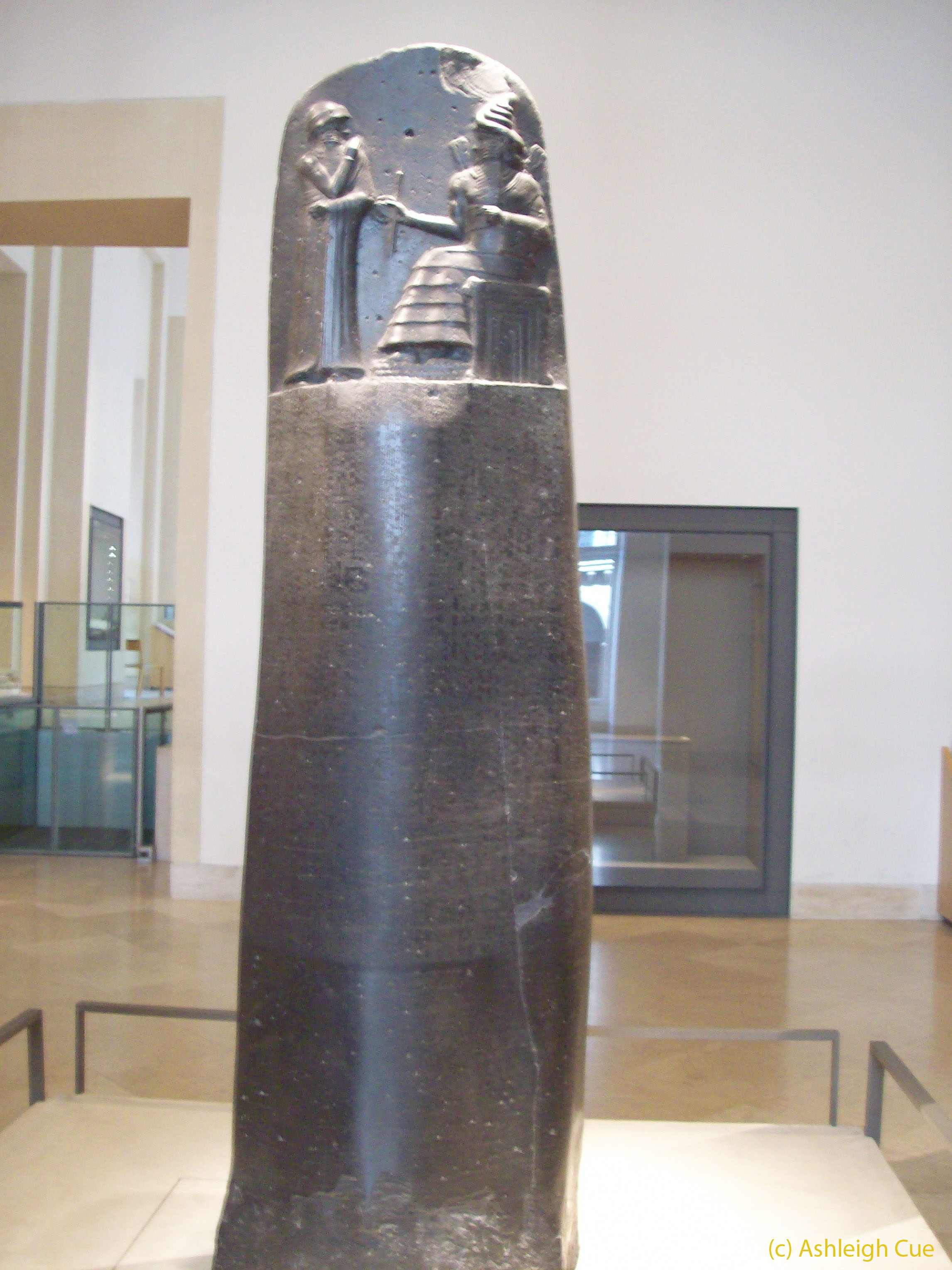 Public knowledge of the artifacts is so hazy, Assange and Friends are still wondering what happened to the original Hammurabi Code- it was always in French custody, at Louvre. Had it fallen in American hands, you can imagine what they would have taken it for! Representation of Hammurabi's..... ahem...this is a family blog..beg your pardon..

Left: Gold plaque, now in New York
Right: Safe at Louvre Museum, Paris:
Hammurabi's Code on a basalt stele (pillar) dates back to 1772 BC and is easily the most priceless Mesopotamian artifact, bearing as it does the earliest recorded human law code, including eye-for-eye-tooth-for-tooth. As we wrote in the last post on debt-relief, there is a reference to cancellation of farmers' debts on the exhibit...
And heyyy...,we don’t spare our own heritage too:
 |
| Al-Omari mosque in Deraa dating to 1090 AD destroyed by ISIS forces in April 2014. |
 |
| The larger Bamiyan Buddha before and after. The three Buddhas representing Gandhar Style date to 500 AD and are located on the famous Silk Route |
And the Cake goes
to…Bamiyan! Islamist scholars maintained that the religion does not support
such acts, even Gen. Musharraf came out strongly against the boorish behaviour
of Taliban. Chandmari at Bamiyan has been a favourite past
time throughout history. According to …ahem..Wikipedia:
“In 1221 with the advent of Genghis Khan a terrible disaster befell Bamiyan (monastery) nevertheless, the statues were spared. Later, the Mughal emperor, Aurangzeb, tried to use heavy artillery to destroy the statues. Another attempt to destroy the Bamiyan statues was made by the 18th century Persian king Nader Afshar, directing cannon fire at them.” Poor statues! The task was finally wrapped up by the Taliban in 2007.
 |
| Diwan-e-khas: indestructible beauty: as it stands today |
And what happened in Delhi in 1857, particularly to the Red Fort, has been ably chronicled by William Dalrymple in Last Mughal. Governor-General Lord Canning had by then turned his back on things Indian. James Fergusson, by whose name the eponymous College goes, was however passionate about preserving this rare heritage., to which Amir Khusrau sang the familiar ode ‘Agar Firdaus bar roo-e zaminast…’
Dalrymple writes:
“All the gilded domes
and most of the detachable marble fittings were stripped and sold off by the
Prize Agents. As Fergusson noted “when we took possession of the palace,
everyone seems to have looted after the most independent fashion. Among
others, a Captain (afterwards Sir) John Jones [who had blown in the Lahore Gate
during the capture of the Fort] tore up a great part, but had the happy idea to
get his loot in marble as table tops. Two of these he brought home and
sold to the Government for 500 pounds, and were placed in the India Museum.”…(according to measuringworth.com, founded by Williamson & Officer, Professors of Economics at University of Illinois, the Income Value of that sum is over £ 4,50,000 in 2013)
“… fragments looted
included the rightly celebrated “Orpheus panel” of pietra
dura inlay which Shah
Jahan had placed behind his Peacock Throne…
“Canning had already
given orders to destroy the Delhi walls and defences, but Lawrence managed to
get the orders rescinded, arguing that there was insufficient gunpowder in
Delhi to blow up several miles of walls…”(http://jaddeyekabir.com/2012/06/29/the-destruction-of-delhi-dalrymple/)
Is there absolutely nothing
we can do for these orphaned relics- before all heritage falls to the industry
of haters and looters? Sorry, in India Courts have shown indulgence to the
vandals, for in these areas, we consider ourselves living in History, and so- how do you try a time-traveller? The mobs are not vandals, they are the 'gau, brahman pratipalak' (*) None else than
an Allahabad High Court Judge has upheld his clansmen’s right to ‘right
perceived wrongs’, just read the Babri Judgement 2010 -in EPW, not anywhere
else, written by Supriya Verma and Jaya Menon of JNU. You'll read that the High Court addresses the fictitious spot as 'Ram-janmabhomi', and the factual mosque, as the 'disputed structure'- so hilarious, were it not tragic..Thus blessed by the High Court, the administration and the ASI establish the existence of temple over temple over temple on the plot, whereas the reality on the ground is a singular magrib wall. This is the prophetic context of Dushyant Kumar's sher, over which Junior and the writer were scratching their heads:
Ek Kabristan me ghar mil raha hai,
Jisme tehkanon me tehkhane lage hain..
..friend I have at last found an abode in a graveyard, where there are basements within basements..!
The culturist vandal doth drive us underground..!
Ek Kabristan me ghar mil raha hai,
Jisme tehkanon me tehkhane lage hain..
..friend I have at last found an abode in a graveyard, where there are basements within basements..!
The culturist vandal doth drive us underground..!
There have been well
intentioned initiatives such as the 1954 Hague Convention for the Protection of
Cultural Property, UNESCO Declaration of 2003 etc. One of the earliest
initiatives was undertaken in 1933 by French activist Raphael Lemkin who
formally defined the heinous activities as ‘cultural genocide’. He wrote - “an
attack targeting a collectivity can also take the form of systematic and
organized destruction of the art and cultural heritage in which the unique
genius and achievement of a collectivity are revealed in fields of science,
arts and literature. The contribution of any particular collectivity to world
culture as a whole, forms the wealth of all of humanity, even while exhibiting
unique characteristics (see http://www.preventgenocide.org/lemkin/madrid1933-english.htm)
The least mankind can do
is to ensure that each country has a legislation ‘in place’ in accordance with
the international conventions. A Standard Operative Procedure has been
prescribed in certain affected countries, like shifting, in an emergency,
museum pieces to specially constructed vaults which can be maintained by an
International Foundation. Should be a key component of Disaster Management
plans. Yah!….we know…!...enactment of a law is useless, but at least the law of
the land may restrain Defence Secretaries from inviting invading armies to rape
the heritage of humankind..
(*) apologies to Pu La Deshpande: this is taken from his observation on the Sangh's Fuhrerphilia: "the Sangh seems to think Hitler was a 'gau-brahman-pratipalak Raja'," he'd say..
(*) apologies to Pu La Deshpande: this is taken from his observation on the Sangh's Fuhrerphilia: "the Sangh seems to think Hitler was a 'gau-brahman-pratipalak Raja'," he'd say..


